Our approach to complex pulling studies
Lane Coburn and Associates brings specialized expertise to Neher-McGrath thermal analysis and complex cable-pulling tension studies.
We coordinate our pulling studies with our in-house Neher-McGrath thermal analysis. These studies are often performed together, allowing our team to evaluate cable ampacity and installation requirements as one coordinated effort.
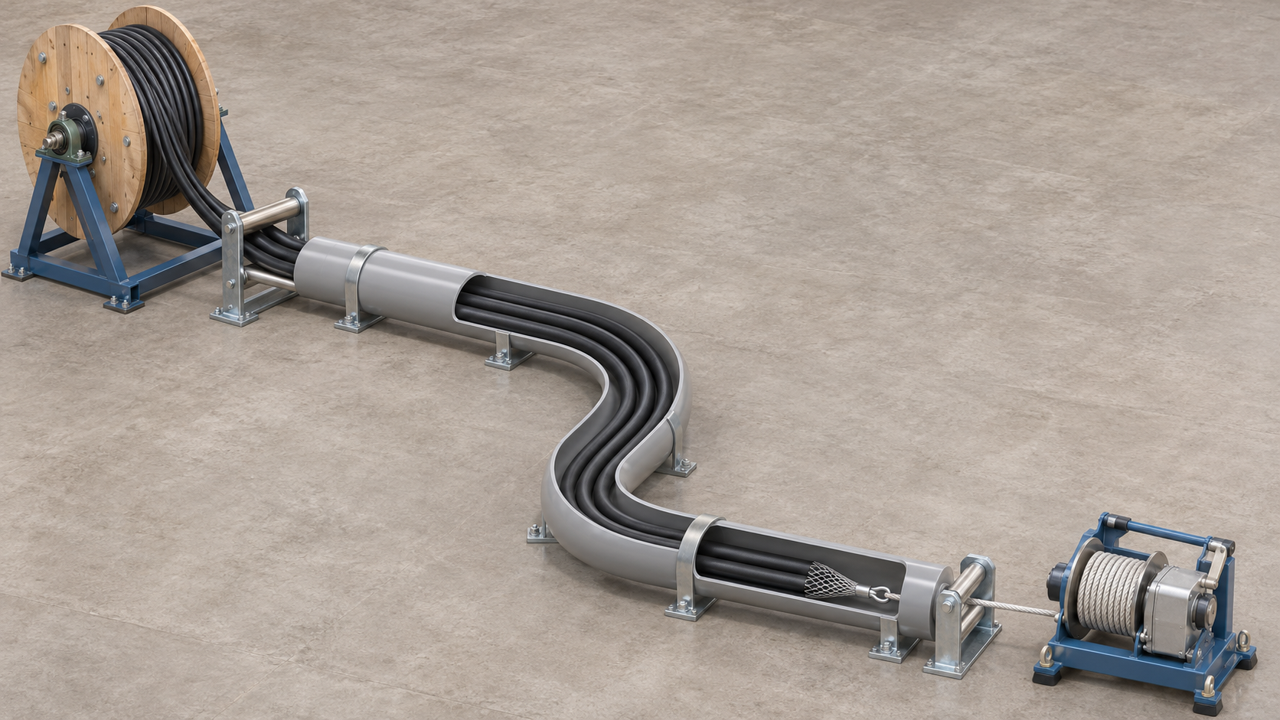
We evaluate the variables that govern each pull, including cable and conduit characteristics, route geometry, bend radii, reel and feed arrangements, lubrication, and the applicable coefficient of friction.
When a modeled pull exceeds the project limits, we develop practical alternatives: reversing the pull direction, reviewing reel sizes and feed arrangements, increasing bend radii, evaluating different conduit and lubricants, or adding access points and calculating shorter pull sections.
We work hand in hand with the end user and installing contractor to develop a safe, practical, cost-effective installation plan. Our calculations document the assumptions, limits, and field verification needed to support the work.
Evaluate the installation before the pull
Cable routing, bends, conductor arrangement and lubrication affect the forces developed during installation. LCA evaluates pulling tension and sidewall bearing pressure against the project’s defined criteria, with the assumptions and remaining field requirements stated clearly.
01 / ANALYSIS
Pulling tension studies
Review complete pull paths, bend forces, pressure and installation assumptions.
02 / FIELD COORDINATION
Installation planning
Coordinate routing, lubricant, attachments, monitoring and field conditions.
03 / CLEAR RESULTS
A usable study package
Give the team a concise conclusion with traceable inputs and supporting calculations.
The route is part of the calculation
A short route with tight bends can create a different installation problem than a longer, straighter pull. The study must represent the actual cable group, bend radii, slopes, feed arrangement and proposed direction.
From project information to an installation decision
1. Establish the basis
Reconcile route schedules and drawings with cable and conduit submittals. Identify missing geometry and define the evaluation criteria before modeling.
2. Evaluate the full pull
Review the proposed continuous pull first. When it does not meet the selected criteria, evaluate supported alternatives such as a changed direction, revised routing or an appropriate pulling break.
3. Communicate the result
Present the conclusion with the governing assumptions, controlling routes, comparison cases and installation qualifications. Changed field inputs may require recalculation.
Discuss your pulling study
Send the route schedule, latest plans and cable/conduit submittals. Contact LCA to define the scope.
Experience with complex cable systems
LCA’s study experience includes IAD 159, IAD 327, IAD 457 / ACB, IAD 458, SJC02 and other data-center, industrial and utility installations. Explore project experience and study scopes.